Thứ Năm, 1 tháng 11, 2012

Travel tips: Getting by train to Sapa


From Hanoi it is a 9-hour train journey to Sapa.

Vietnam Rail operates some of the cars, but other cars in the train are operated by private companies (Tulico, Ratraco, Victoria Hotels, and others). Some of these cars are significantly nicer than the standard cars. You may need to arrange with a travel agency to get tickets on these tourist cars, but any traveler can purchase tickets for the VNR cars at the Hanoi train station.

Cheaper tickets, especially in hard sleeper class, can be hard to come by at times, as tour companies and travel agents will snap up these to foist on their own customers (too frequently a promised soft sleeper berth will turn into a hard sleeper when it comes time to board). To avoid rip offs better go to the train station by yourself and get the ticket from the ticket office. This is the only way to make sure that you will get what you have paid for. Travel Agencies in Vietnam are known for their bad business practice. Another possibility is to ask for help at your hostel (if it's a good one).


Insider travel tip:
Although one cannot be assured of finding a place, it is often possible to arrive at the station a short while before boarding time, as there are usually young men hanging around trying to hawk unfilled berths at the last minute. The price of these tickets will fall dramatically as departure time draws near.

Prices vary according to both the type of seat purchased and the season during which you are traveling. The times around Vietnamese holidays are particularly expensive and tickets cannot be assumed available for same day travel, so book ahead if possible. Travelers are recommended to purchase a berth in a soft or hard sleeper car, though the trip in soft seat class is not intolerable (that's what we did and it was ok). For a bed, expect to pay in the area of 150,000-250,000 dong (one-way). There is usually a dining car serving good, surprisingly affordable noodles (8000 dong) and rice porridge (6000 dong), but it's always wise to bring your own snacks and drinks as well.

The train ends at Lao Cai. From there, dozens of shuttle buses will be waiting outside the station to take you the remaining distance to Sapa, usually at a 'fixed' rate of 25,000 dong. It's often possible to bargain down to 20,000 dong or lower, depending on demand. The ride is about an hour of beautiful views (if the weather is good, it may be an hour of fog at other times) more than 1000 meters up into the mountains.

You may want to book a return ticket when you buy your outward journey, as picking up tickets in Lao Cai is harder than in Hanoi. The staff do not speak as much English, and they possibly only sell tickets for travel on the same day so sleepers may already be sold out unless you go first thing in the morning. Pay attention to the time of your return train. Trains leaving Lao Cai around 7PM will arrive in Hanoi at 4AM. If you don't make prior arrangements to return at an early hour, you may find yourself sitting outside of your hostel, waiting for the desk to open.

Another possibility is to get a bus ride to Dien Bien Phu at the northern border to Laos. That's a complete day in the bus, riding through terrific landscapes!

Source: traveldudes


Thứ Năm, 6 tháng 9, 2012

Vietnam’s best tourist attractions

 VIETNAM - Many visitors to Vietnam have been impressed by the unique beauty of the scenery.

The first place to see the crack of dawn

Mui Dien in Phuoc Than village, Hoa Tam Commune, Dong Hoa district, in the south-central province of Phu Yen is the first place in Vietnam to greet the dawn.

Visitors will have the chance to see the first rays of the rising sun and its reflection in the sea. The best view is from the 26-metre light house, which was built by the French in the late 19th century.

It is very convenient for tourists to get to Mui Dien by car as there is a road leading up to the peak from the bay, not far from the sand dunes at the foot of the hill. In the evening, visitors can enjoy eating grilled fish while listening to the tales of the lighthouse watchmen.

The hottest region

Cua Rao is located in the Lam River Junction, 60 kilometres from Phu Mat forest, but its temperature always goes up to 37OC after 9am. During winter days, it is still very hot with a blazing sun. 

The changing Sand Dunes

The White Sand Dunes is a top attraction at Mui Ne in Phan Thiet town, in southern Binh Thuan province. Affected by Northeastern and Southwestern winds, they change rapidly, both in shape and colour.

In addition, visitors can enjoy the full contact of sand boarding. 5am-6am is considered the best time for this sport.

The longest oversea bridge

The 7-km Thi Nai Bridge, which connects Qui Nhon City and Phuong Mai Peninsula has become the longest oversea bridge since it was completed in December 2006.

From Qui Nhon City or the Phuong Mai Peninsula, visitors can enjoy seeing the charming bridge over the blue river and the reflection of the Thay Boi (Fortune-teller) tower in the calm water, as well as the Swallow Ground (Bai Nhan) and the Bird Hillock (Con Chim) in the distance.

The longest house

Built in 2002, the 85-metre long thatch-roofed house in Gia Lanh ethnic village, Krong Na Commune, Buon Don District in the Central Highland province of Dak Lak is considered the longest in Vietnam.

The interior of the house is decorated in the unique traditional style of the Central Highland people, with rafter, papoose and cooking fire. Visitors pay VND15,000 (US$0.7) for entry and another VND150,000 (US$7) if they want to spend overnight there in one large, common bedroom.

  Cathedral with the biggest bells

Notre Dame Cathedral of Saigon, located in Paris Commune, district 1, Ho Chi Minh City, is a magnificent cathedral which was built with material imported from France.

 The cathedral has a set of six large bronze bells weighing 28.85 tons, in the musical syllables of sol, la, ti, do, re and mi. All these bells, which were cast in France, are considered the biggest in Vietnam.


The biggest Jesus Statue

Built on Tao Phung Mountain in Vung Tau City, the 32-metre-tall Jesus Statue is the biggest with his arms stretching 18.4 metres long, on a 4-metre-high concrete base with a beautiful carving of the last supper of Jesus and his 12 apostles.

Inside the statue, visitors will be able to climb a 133-step spiral staircase to his arms and stand on his shoulders to enjoy panoramic views of the sea and mountain.

Source: travelweeklyasia

See also: 

Discovery Indochina tour

Thứ Ba, 17 tháng 7, 2012

Phnompenh - pearl of Asia

Phnom Penh is the vibrant bustling capital of Cambodia. Situated at the confluence of three rivers, the mighty Mekong, the Bassac and the great Tonle Sap, what was once considered the 'Gem' of Indochina. The capital city still maintains considerable charm with plenty to see. It exudes a sort of provincial charm and tranquillity with French colonial mansions and tree-lined boulevards amidst monumental Angkorian architecture. Phnom Penh is a veritable oasis compared to the modernity of other Asian capitals. A mixture of Asian exotica, the famous Cambodian hospitality awaits the visitors to the capital of the Kingdom of Cambodia.  


See more: Phnompenh tour


Thứ Tư, 27 tháng 6, 2012

Video: Vietnam Central in foreign's eyes

The majority of travellers who visit Vietnam usually come through Ho Chi Minh City or Hanoi. While these 2 heavyweights of Vietnamese tourism still hold their ground, travellers are starting to spend more of their time and dollars in the central cities of Hoi An and Da Nang. The are close together and any trip to one should require a trip to the others. Today we’re going to feature these 2 beautiful cities, each with their own vibe and attractions.

Danang - Hoian Travel


See more: 

Vietnam central tour

Thứ Sáu, 22 tháng 6, 2012

Doan Ngo Festival (Tết Đoan Ngọ)


Doan Ngo Festival”, also called “Tết giết sâu bọ” (translated as Festival for “Killing the persons’ inner insects”), is the second most significant festival (to the Lunar New Year Tet Holiday) of Vietnam. What does these names mean?   Literally, Tet refers to festival, Doan means the start, Ngo is the seventh animal of the Chinese zodiac- the horse. Doan Ngo festival is also known as Tết sâu bọ (sâu bọ = worms, pests) or Tết tháng 5, to be celebrated on the 5th day of the 5th lunar month.

 The name “Tet sau bo” derives from the fact that farmers, on this day, get rid of all pests to start growing their crops for the new season. Therefore, creatures and people must become stronger in both their health and their souls to overcome this. On this occasion, the whole family have to get up early and eat fermented sticky and fruits. The worshipping is held at noon, hour of Ngo. The tradition of eating dumplings, especially lye water dumplings, extends from the belief that the dumplings will cleanse one’s body of any unwanted “parasites”.

Two irreplaceable dishes  

The two traditional types of food to be eaten on this holiday are banh u and com ruou. Banh u is pyramidal sticky rice cakes wrapped in banana leaves. They are often stuffed with beans and banana leaves’ essence, creating its dominant flavor.

Com ruou, which literally translates as “rice wine,” are little balls of fermented rice bathed in wine. Com ruou is associated with the myth telling that a long time ago, there were two orphan brothers living together in a small village. They were popular among the locals for their intelligence and kindness. Also, in that village, there were two snakes Thanh Xa and Bach Xa, which after long lives, turned into spirits.  Falling in love with the brothers, they transformed themselves into beautiful ladies to lure the men. Their desire soon became true, Thanh Xa got married the older

 They lived happily together until the men grew unhealthy each passing day, scared of daylight and lived in festering darkness. The locals suspected the presence of a bad spirit, and one day, luckily, a Taoist hermit passed by the village. After being told the affliction, he conducted some spirit type tests and found out that the men’s house had a case of the evils. Brewing a wine potion, he told the locals to feed it to the men. The brothers must eat the potion’s solids and liquids in the early morning of the next fifth day of the fifth lunar calendar.  As soon as the men tucked into their special breakfast, their wives were turned into their real appearance of snakes, before disappearing in a puff of smoke, freeing the brothers.  Since that day, people have eaten “ruou nep” on Killing the Insect Day, in the hope of driving away bad spirits.

    The process of making Com ruou is not quite complicated but time-consuming.  In order to have good com ruou in Doan Ngo Festival, the famers must harvest the reaped rice from a paddy, dried and pounded carefully to keep the most nutritious part of the rice. At first, the rice is steamed twice for about 30 minutes and left for a while to get cool. After that, It is mixed with yeast, before being left for two or three days to ferment, depending on the weather.  Com ruou is eaten early on this day to fight the “worms” in one’s stomach.

Just try it, you will see that Com ruou brings you a strong and quite delicious taste. In the Vietnamese traditional concept, com ruou can kill any parasites in the body. Vietnamese people, from adults to kids, mostly like eating com ruou, yet, adults are more inclined to gain its curing effects with a grain of salt.

Up to now, besides the Lunar New Year Holiday, Doan Ngo Festival plays a significant role in every Vietnamese life for practical and holy meanings. Enjoying the atmosphere of Doan Ngo Festival, you will get to know more about its value and spirits.

Source: Vietnambeauty

You might like to read:


Popular Vietnam festival


Chủ Nhật, 17 tháng 6, 2012

Cu Chi tunnels in a half-day tour

The Cu Chi tunnels are a site worth seeing if you are visiting Saigon. However, since they are roughly 70km round trip from the city centre, visiting them on a tour can take the majority of a day. When time in the city is limited they may seem unreachable, but fear not: you can get there and back and still have half a day to spare.

Start by hiring a taxi for the trip. You should do this the night before because you are going to want to get an early start to the day. The taxi will cost around 800,000 VND, giving you a round trip to the tunnels and a taxi for six hours; each additional hour will cost 50,000 extra. Have the taxi pick you up at 6:00, putting you in Cu Chi when it opens at 7:00.

Being early is an advantage because you beat the larger tour groups, which is great because you don’t have to wait for them to slowly go through the narrow tunnels. Also, since you came to the tunnels independently, you are not part of a larger tour group, giving you a more intimate experience with your tunnel guide.


Because you won’t be waiting for the tour group stragglers, you’ll have much more time in the tunnels for pictures, and if you’re lucky your guide may be a bit of a photographer himself. One thing to watch out for, however, is that because you will be one of the first people through the tunnels, the bats that inhabit these underground areas may not yet have been scared off to other hiding spots. Be prepared to feel a bat brush by on your crawl through.

After you explore the tunnels, you will still have plenty of time to check out other nearby attractions such as the memorial temple, Cu Chi village, the shooting gallery, and even grab a bite to eat. Then it’s back to your taxi and Saigon, where you will still have the rest of the day to explore.

This half-day option works best if you are in a group of three or more, because you can save time and split the taxi fare. For a cheaper tunnel excursion try the bus. Go to Thanh bus station (opposite Ben Thanh market) take bus number 13 for 7,000 VND (from Saigon to Củ Chi) and then take a second bus, number 79 for 5,000 VND(Củ Chi- Dầu Tiếng). Remember to check returning bus times before enjoying the tunnels.

Source: travelfish

See more:
Cu Chi tunnel tour

Thứ Năm, 31 tháng 5, 2012

The Perfect Cup of Coffee in Vietnam

Once upon a time, coffee wasn’t a part of Vietnam. Coffee in Vietnam was introduced by the French during their period of colonization. Along with crusty loaves of bread, sweet pastries and creamy pâté, coffee remained after the country gained independence, and began to integrate itself into the Vietnamese culture.
Traveling to Vietnam, you will be immersed in a coffee culture that appears to have been there forever.
The highland areas of Vietnam offer an ideal climate and elevation for the cultivation of coffee beans. For this reason there is a diverse range of coffee species that are produced – each bringing offering a unique savoring taste.
Nowadays, coffee is one of Vietnam’s biggest exports and they are second only to Brazil in world coffee production.
 

The RoastingAfter harvesting, coffee beans in Vietnam are often roasted dark. They are not quickly blackened, but slowly roasted over low heat for a long period of time.
This roasting technique, as well as the way the coffee is brewed, is integral to the full bodied flavor that Vietnamese coffee is so famous for.

 The Brewing

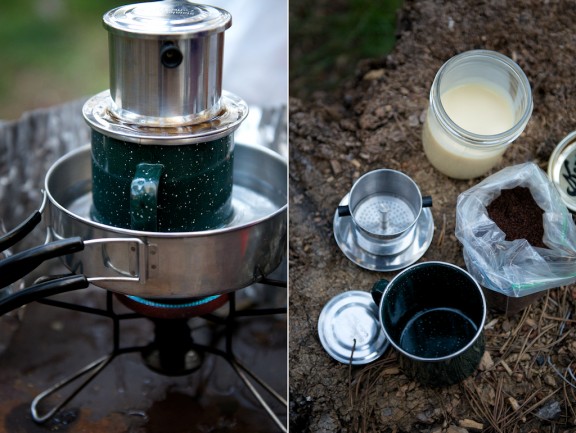
One of the most popular ways to brew a cup of coffee in Vietnam is using a very simple, single-cup gravity drip system. The device starts off with a metal cup that has tiny holes at the bottom.

Ground coffee is placed on the bottom of the cup and pushed down with a small circular piece that fits within the cup. The metal cup is placed over a real coffee cup and hot water is poured into the metal device.

Most likely, when you order a cup of coffee in Vietnam, it will be served this way.

 What kind of coffee should I drink in Vietnam?
 
Ca phe sua da – One of the most popular brews, especially when taking a break from the intense rays of the sun, is black coffee mixed with a dose of sweetened condensed milk and served on cubes of ice. The result is a rich chocolatey blend.
Ca phe sua nong – Identical to the brew mentioned above, except this variation is served hot.
Ca phe den nong – To get the real sense of Vietnamese coffee try a cup of robust pitch black coffee devoid of any additives.
Ca phe chon (Weasel Coffee) – Have you heard of “poop coffee?” This gourmet coffee which is similar to kopi luwak in Indonesia (though from a civet cat) is among the priciest beans in the world.

 Essentially coffee beans are fed to weasels who fail to digest them and end up depositing the whole beans in their feces. Someone then has the pleasure of digging out the beans and after that they are ready to be served! OK, there’s a bit more to it than that, but that’s just a quick briefing.

I had a couple of cups of weasel coffee in Hanoi, and I was truly impressed. The coffee was brewed strong, but even though I drank it completely black, there was absolutely zero acidity and none of that sourness that might come from a regular cup of black coffee.
So how can I fully enjoy drinking a cup of Vietnamese coffee?

You might remember that Vietnam takes things to the street, and coffee is among the leaders in that field.

Hanoi coffee shops are everywhere to be seen and impossible to miss. Grab a 6-inch stool, and pull yourself up to a street coffee shop in Vietnam. Order a couple of rounds, and you’ll be ready to start the day. In another few hours, stop again and order another!

People don’t just drink an energy buzzing shot of java in the morning, many partake throughout the entire day. A quick ca phe sua da is a battery charge that allows you to keep going, fighting the traffic, working, or plugging away on whatever task may be at hand.

By the way, as I sit here writing this, I’m happily sipping on a cup of black Vietnamese coffee!

Source: backpacker